
AI Data Pipelines: How Businesses Turn Raw Data Into Intelligent Automation
Businesses are generating more data than ever before. Websites, APIs, CRM platforms, databases, documents, spreadsheets, online marketplaces and internal applications continuously create valuable information.
But collecting large amounts of data is only the beginning.
The real challenge is turning raw business data into structured information, useful insights and automated actions.
This is where AI data pipelines are becoming increasingly important.
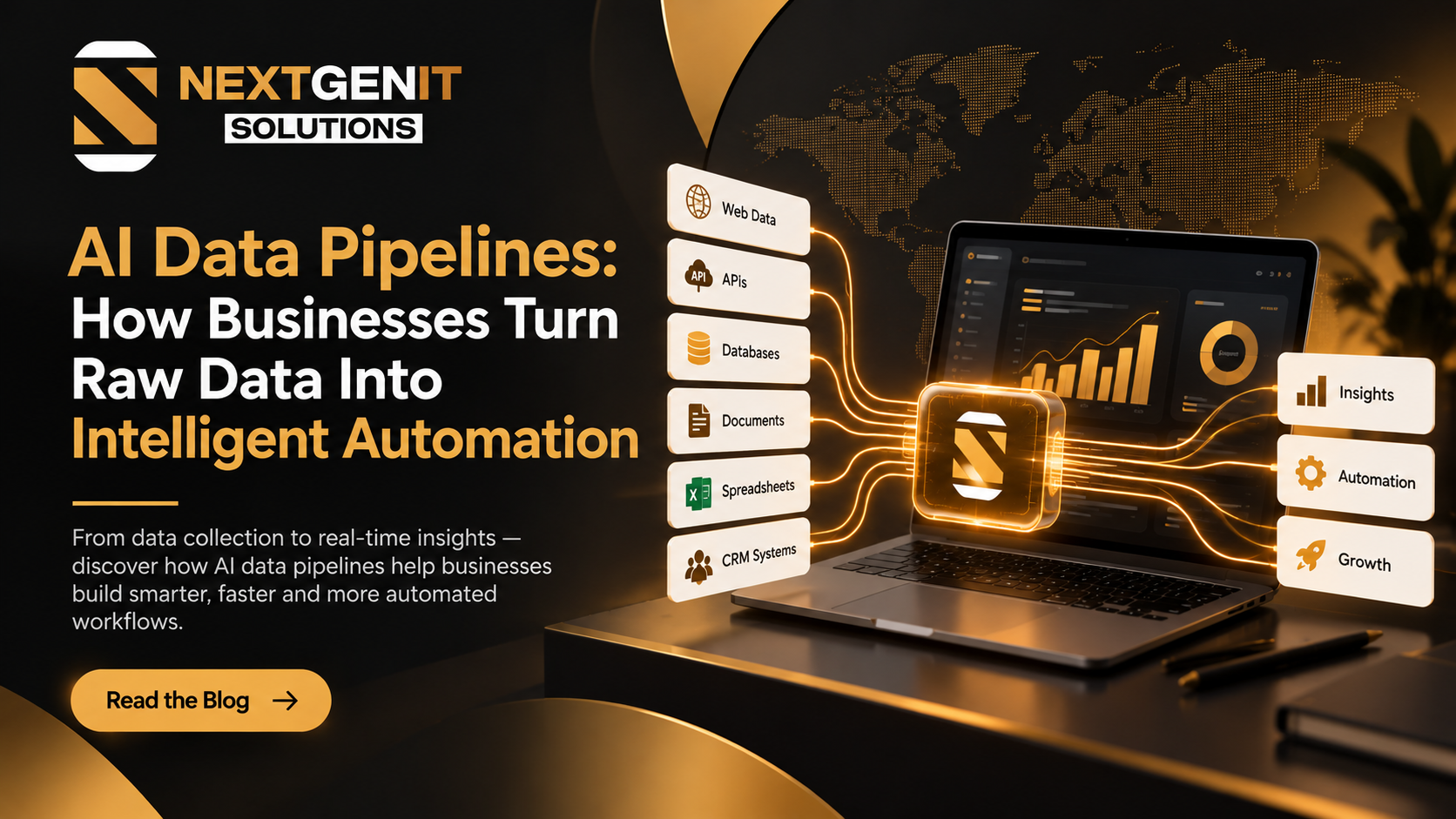
An AI data pipeline connects data collection, data processing, artificial intelligence, analytics, software applications and workflow automation into a connected business system.
Data → Processing → AI → Automation → Business Action
At Nextgenit Solutions, we help businesses build AI-powered software, data pipelines, web scraping systems, automation workflows, SaaS platforms, dashboards and API integrations designed around real business requirements.
What Is an AI Data Pipeline?
An AI data pipeline is a technology workflow that collects data from one or more sources, cleans and validates the information, stores it in a structured format, and makes it available for artificial intelligence, analytics and automated business processes.
A typical AI data pipeline can follow this process:
Data Sources → Data Collection → Data Cleaning → Data Validation → Data Storage → AI Processing → Automation → Business Action
This approach allows businesses to move from disconnected data sources to a more intelligent and automated operating model.
Why AI Depends on High-Quality Data
Artificial intelligence is highly dependent on the quality of the information it receives.
Duplicate records, incomplete information, inconsistent formats, outdated data and incorrect values can affect the reliability of downstream analysis and automation.
That is why data quality and data engineering are important parts of an AI implementation.
Before data reaches an AI model, businesses may need to clean, normalize, validate and organize the information.
Step 1: Collect Data From Multiple Sources
The first stage of an AI data pipeline is data collection.
Depending on the business use case, information can come from:
- Websites and online marketplaces
- Business APIs
- CRM systems
- Internal databases
- CSV and Excel files
- Documents and reports
- Customer forms
- Business applications
- Public web data sources
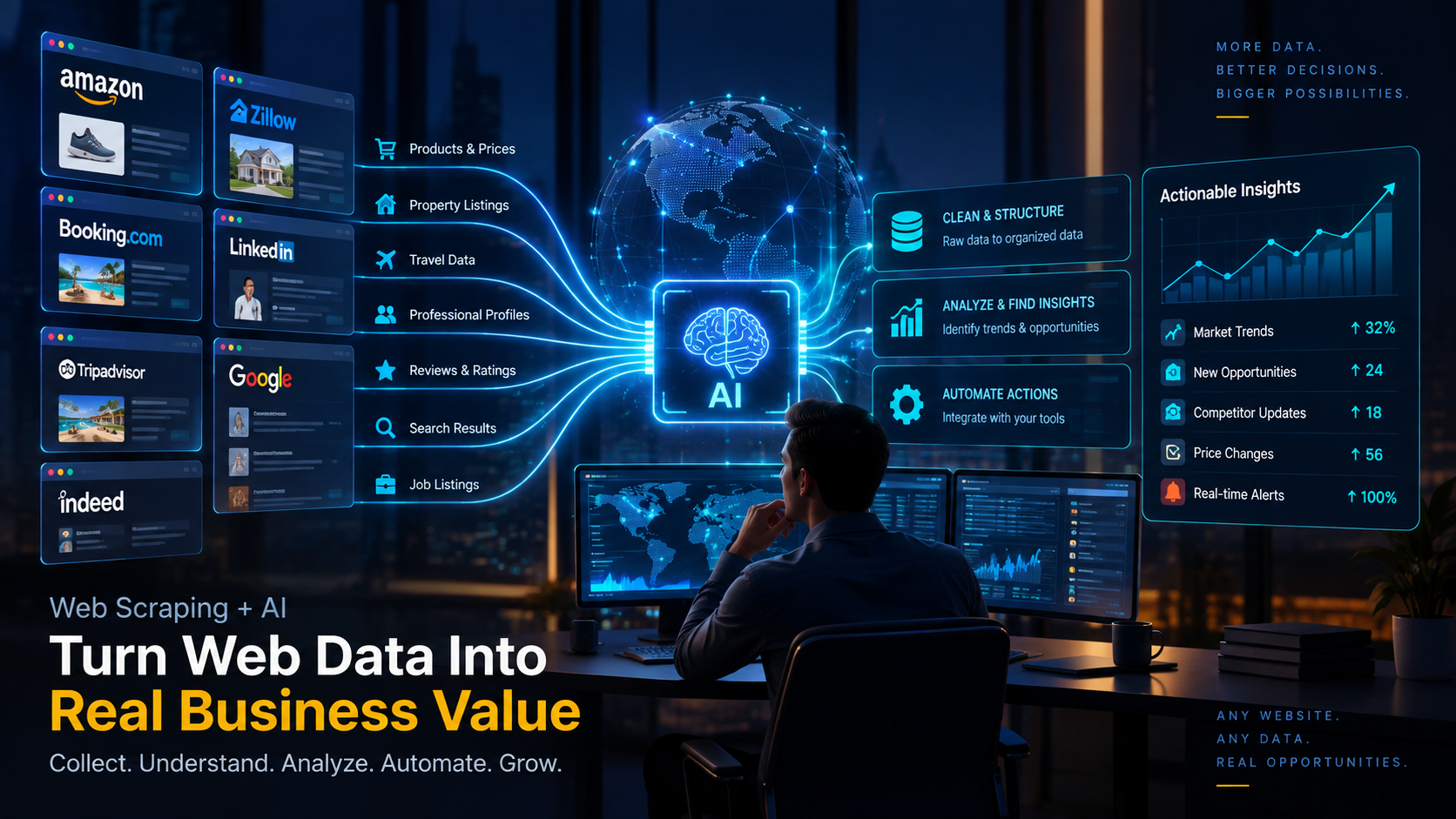
For businesses that depend on external information, web scraping and web crawling can become an important part of the data collection process.
Nextgenit Solutions develops custom web scraping and data extraction solutions that can collect publicly available web information and convert it into structured data for analysis, dashboards and automated workflows.
Step 2: Clean and Structure Business Data
Raw data is rarely ready for direct use.
Different websites, platforms and business applications often use different formats, field names, naming conventions and data structures.
For example, one source may use Product Price, another may use Selling Price, and another may display Current Price.
A well-designed data processing pipeline can transform these different formats into a standardized structure.
Common data-processing activities include:
- Data cleaning
- Data normalization
- Duplicate removal
- Data validation
- Category mapping
- Missing-value handling
- Data transformation
- Format standardization
This creates a cleaner and more reliable foundation for AI applications and business intelligence systems.
Step 3: Store Data for AI and Business Intelligence
After data has been cleaned and structured, it needs to be stored in a way that supports the business workflow.
Depending on the size and requirements of the project, businesses may use databases, cloud storage, search systems, data warehouses or other storage technologies.
Historical data can also provide valuable context by allowing businesses to compare current information with previous records.
This can be particularly useful for market intelligence, pricing analysis, customer analytics, business intelligence and trend monitoring.
Step 4: Use AI to Analyse Business Data
Once the data pipeline is producing reliable and structured information, businesses can introduce AI into the workflow.
AI-powered data processing can support many practical business tasks, including:
- Data classification
- Information extraction
- Document analysis
- Text summarization
- Intelligent search
- Recommendation systems
- Pattern identification
- Lead classification
- Business data analysis
- Decision-support workflows
The objective should not be to add AI to every process.
The objective is to use AI where it can provide meaningful value within a specific business workflow.
Step 5: Connect AI With Business Automation
The biggest opportunity often appears when AI is connected to workflow automation.
Instead of simply generating information, the system can use that information to trigger the next business action.
For example:
Website data is collected
↓
Data is cleaned and normalized
↓
Records are matched
↓
Important changes are identified
↓
AI analyses the information
↓
Dashboard is updated
↓
Notification or workflow is triggered
This turns an AI capability into a practical AI business automation system.
AI-Powered Competitive Intelligence
Competitive intelligence is one of the practical applications of combining web data, AI and automation.
Businesses may need to monitor competitor pricing, products, availability, offers, new listings or other market information across multiple online sources.
A manual process can require employees to repeatedly visit websites, collect information and update spreadsheets.
An automated competitive intelligence system can instead collect public information, process the data, compare historical records and highlight important changes.
AI can then help summarize those changes and provide structured insights for business teams.
This can support industries such as ecommerce, retail, real estate, recruitment, market research and other data-driven businesses.
AI Data Pipelines for Ecommerce Businesses
Ecommerce businesses often operate with rapidly changing product information.
Prices, availability, discounts, seller information and product listings can change frequently.
An AI-powered ecommerce data pipeline can collect information from relevant sources, normalize product data, compare historical records and identify meaningful changes.
Businesses can use this information for:
- Competitor price monitoring
- Product intelligence
- Market research
- Availability tracking
- Product comparison
- Automated reporting
- Business alerts
AI Data Pipelines for SaaS Platforms
Modern AI SaaS development often requires more than simply adding an AI API.
An intelligent SaaS platform may need to collect data, process documents, search information, generate insights, trigger workflows and connect multiple business systems.
This requires an application architecture where:
Data + AI + APIs + Database + Automation + User Interface
work together as one system.
Nextgenit Solutions develops SaaS applications, MVPs, dashboards, APIs and custom software solutions that can incorporate AI and automation into business workflows.
Real-Time and Scheduled Data Processing
Not every business needs real-time data processing.
Some workflows may require daily updates, while others may require hourly or more frequent processing.
The appropriate approach depends on the business use case, data source, operational requirements and system architecture.
A well-designed data pipeline should therefore provide an appropriate balance between data freshness, processing performance, reliability and operational cost.
Why Data Volume Alone Does Not Create Better AI
More data does not automatically mean better results.
A large dataset can still contain:
- Duplicate records
- Incorrect information
- Outdated information
- Missing fields
- Inconsistent formats
- Irrelevant records
A smaller dataset that is relevant, structured and properly validated may be more useful for a particular AI workflow than a much larger dataset containing substantial noise.
This is why AI data quality should be considered as important as AI model selection.
Human Oversight in AI Automation
AI automation does not mean that every business decision should be fully automated.
Some tasks can be completely automated, while others benefit from human review.
A practical AI workflow may therefore follow different levels of automation:
Assist: AI prepares information for a user.
Recommend: AI analyses information and suggests an action.
Automate: The system performs a predefined action.
Escalate: Unusual or uncertain cases are sent to a human for review.
This approach can help businesses automate repetitive work while keeping people involved where judgment and accountability are important.
AI Solutions for UK, USA and Global Businesses
Businesses across the UK, USA, Europe, Canada, Australia and other international markets are exploring AI, automation and data-driven software to improve operational efficiency.
AI data pipelines can support many business use cases, including:
- AI business automation
- Web data extraction
- Competitive intelligence
- Ecommerce intelligence
- Lead management
- Document processing
- Customer support automation
- Market research
- Business intelligence dashboards
- Custom AI software
- AI-powered SaaS applications
The implementation should always be designed around the company's specific workflow, data sources, technology environment and applicable data-protection requirements.
Why Businesses Need Custom AI Software
Every organization has different workflows, data sources and operational requirements.
One company may need an AI-powered competitive intelligence platform, while another may need document automation, customer-support automation, lead processing or an intelligent SaaS application.
Custom AI software development allows businesses to build technology around their actual operational requirements instead of forcing their processes into a generic solution.
From Raw Data to Intelligent Business Operations
The real value of an AI data pipeline comes from connecting every stage of the process.
Collect → Clean → Structure → Store → Analyse → Automate → Act
This allows businesses to move from raw data to useful intelligence and then from intelligence to automated action.
Instead of treating web scraping, AI, databases, automation and software as separate technologies, they can be designed as parts of one connected business system.
How Nextgenit Solutions Helps Businesses Build AI-Powered Systems
Nextgenit Solutions provides technology services across AI solutions, web scraping, web crawling, data processing, workflow automation, SaaS development, custom software development, dashboards and API integration.
Businesses can combine these capabilities to create solutions around specific operational challenges.
A typical architecture may look like:
Web Data → Data Pipeline → AI Processing → Database → API → Dashboard → Automation
This approach helps businesses turn fragmented information into structured, accessible and actionable business data.
Why Choose Nextgenit Solutions for AI and Automation?
Businesses looking for a technology partner for AI development, automation, web scraping, SaaS development and custom software often need more than an isolated software feature.
They need a solution that connects data, applications and workflows.
Nextgenit Solutions focuses on building technology around business requirements, helping organizations transform manual and disconnected processes into more structured digital workflows.
The Future of AI Is Connected to Data
The future of business AI is not only about selecting a powerful AI model.
It is about building reliable systems around that model.
The combination of:
Reliable Data + AI + Automation + Software + Human Oversight
can help businesses create intelligent systems that support everyday operations and data-driven decision-making.
Conclusion
AI is only one part of a successful intelligent business system.
The data pipeline behind the AI plays an equally important role.
Businesses that collect the right information, clean and structure their data, connect software systems, apply AI where it provides value and automate repetitive workflows can create more useful and scalable digital operations.
Nextgenit Solutions helps businesses build AI-powered data pipelines, automation workflows, web scraping systems, SaaS platforms, dashboards, APIs and custom software solutions.
Whether your business needs AI automation, data extraction, competitive intelligence, intelligent software or a custom SaaS application, the right approach starts by understanding the data and workflow behind the business problem.
Build Your AI-Powered Business System With Nextgenit Solutions
Explore Nextgenit Solutions for AI development, web scraping, automation, SaaS development, API integration and custom software solutions for businesses in the UK, USA and global markets.
Website: https://www.nextgenit.co.in/
Nextgenit Solutions — Building intelligent software around real business needs.